

Stainless Steel Panel Grades: 304 vs. 316 vs. 430 for Commercial Use
Feb 4th 2026
Stainless steel panels are a staple in commercial environments—from food processing plants and commercial kitchens to hospitals, laboratories, retail spaces, and exterior architectural applications. Their durability, clean appearance, and resistance to corrosion make them a preferred material across industries.
But not all stainless steel panels are created equal.
Three of the most commonly specified grades for commercial use are 304, 316, and 430 stainless steel. Each has distinct chemical compositions, performance characteristics, and cost implications. Choosing the wrong grade can lead to premature corrosion, unnecessary expense, or performance issues—while choosing the right one can extend service life and reduce long-term maintenance costs.
This guide breaks down the differences between 304 vs. 316 vs. 430 stainless steel panels, explains where each excels, and helps you determine the best option for your commercial application.
Understanding Stainless Steel Grades
Stainless steel is an alloy primarily composed of iron, chromium, and varying amounts of other elements. The key to its corrosion resistance is chromium: when exposed to oxygen, chromium forms a thin, self-healing passive layer that protects the steel beneath.
The differences between stainless steel grades come down to:
-
Chromium content
-
Nickel content
-
Additional alloying elements (such as molybdenum)
-
Crystal structure (austenitic vs. ferritic)
These factors influence corrosion resistance, strength, formability, magnetic properties, and cost.
Grade 304 Stainless Steel Panels
Overview
304 stainless steel is the most widely used stainless steel grade in commercial applications. It belongs to the austenitic family and contains approximately 18% chromium and 8% nickel, often referred to as “18/8 stainless steel.”
Key Properties
-
Excellent corrosion resistance in most environments
-
Non-magnetic (in annealed condition)
-
High formability and weldability
-
Smooth, attractive finish options
-
Good strength at high and low temperatures
Advantages for Commercial Use
304 stainless steel panels offer an ideal balance between performance and cost. They resist oxidation, moisture, and many chemicals commonly encountered in indoor commercial settings. Because of their workability, they are easy to fabricate into wall panels, backsplashes, equipment enclosures, and decorative architectural features.
Common Applications
-
Commercial kitchen wall panels and backsplashes
-
Food processing facilities
-
Restaurant equipment cladding
-
Hospital and healthcare interiors
-
Laboratory wall systems
-
Retail and hospitality design elements
Limitations
While 304 performs well in most environments, it is not ideal for high-chloride or marine conditions. Exposure to salt, de-icing chemicals, or coastal air can lead to pitting corrosion over time.
Cost Considerations
304 stainless steel is mid-range in cost. It is more expensive than ferritic grades like 430 but significantly less costly than 316, making it the default choice for many commercial projects.
Grade 316 Stainless Steel Panels
Overview
316 stainless steel builds on the strengths of 304 but adds molybdenum (typically 2–3%), which dramatically improves corrosion resistance—especially against chlorides and harsh chemicals.
Key Properties
-
Superior corrosion and pitting resistance
-
Excellent performance in marine and coastal environments
-
Non-magnetic
-
High durability and longevity
-
Slightly lower formability than 304, but still very workable
Advantages for Commercial Use
316 stainless steel panels are the gold standard for harsh or corrosive environments. The addition of molybdenum makes this grade far more resistant to salt spray, cleaning chemicals, and acidic substances. For applications where failure is not an option, 316 is often specified despite its higher cost.
Common Applications
-
Coastal and marine architecture
-
Commercial kitchens using aggressive cleaning agents
-
Pharmaceutical and chemical processing facilities
-
Medical and surgical environments
-
Exterior architectural panels
-
Food and beverage production plants
Limitations
The main drawback of 316 stainless steel is cost. It is significantly more expensive than both 304 and 430 due to its alloying elements. For standard indoor applications, it may be over-engineered.
Cost Considerations
316 is the most expensive of the three grades, but it often provides the lowest total lifecycle cost in corrosive environments by minimizing maintenance, replacement, and downtime.
Grade 430 Stainless Steel Panels
Overview
430 stainless steel is a ferritic grade containing approximately 16–18% chromium and little to no nickel. This composition makes it more affordable but also less corrosion-resistant than austenitic grades.
Key Properties
-
Magnetic
-
Good resistance to mild corrosion and oxidation
-
Lower cost due to lack of nickel
-
Limited formability compared to 304 and 316
-
Not ideal for welding or severe environments
Advantages for Commercial Use
430 stainless steel panels are cost-effective and visually appealing for low-moisture, indoor applications. They still provide the clean look of stainless steel but at a lower price point, making them attractive for budget-sensitive projects.
Common Applications
-
Appliance panels and trim
-
Interior decorative wall panels
-
Elevator interiors
-
Retail fixtures
-
Dry indoor environments
Limitations
430 stainless steel has reduced corrosion resistance, especially in humid or chemically aggressive settings. It can rust if exposed to moisture for extended periods and is not recommended for food processing or outdoor use.
Cost Considerations
430 is the least expensive option, making it appealing where appearance matters more than long-term corrosion resistance.
Side-by-Side Comparison
| Feature | 304 Stainless Steel | 316 Stainless Steel | 430 Stainless Steel |
|---|---|---|---|
| Corrosion Resistance | Excellent (general use) | Superior (chlorides, marine) | Moderate |
| Nickel Content | Yes | Yes | No |
| Molybdenum | No | Yes | No |
| Magnetic | No | No | Yes |
| Cost | Medium | High | Low |
| Best For | Most commercial interiors | Harsh & exterior environments | Dry, indoor decorative use |
Choosing the Right Stainless Steel Panel for Your Project
When selecting between 304, 316, and 430 stainless steel panels, consider the following factors:
1. Environmental Exposure
-
Indoor, dry environments: 430 may suffice
-
Moist or food-service environments: 304 is typically ideal
-
Salt, chemicals, or outdoor exposure: 316 is the safest choice
2. Cleaning and Maintenance
Facilities with frequent washdowns or harsh cleaning chemicals benefit from the added protection of 316 or 304.
3. Budget vs. Lifecycle Cost
While 430 is cheaper upfront, it may require replacement sooner in demanding environments. 316 costs more initially but often saves money long-term.
4. Aesthetic Requirements
All three grades can achieve attractive finishes, but austenitic grades (304 and 316) generally maintain their appearance longer under heavy use.
Final Thoughts
Selecting the correct stainless steel panel grade is not just a technical decision—it’s a strategic one.
-
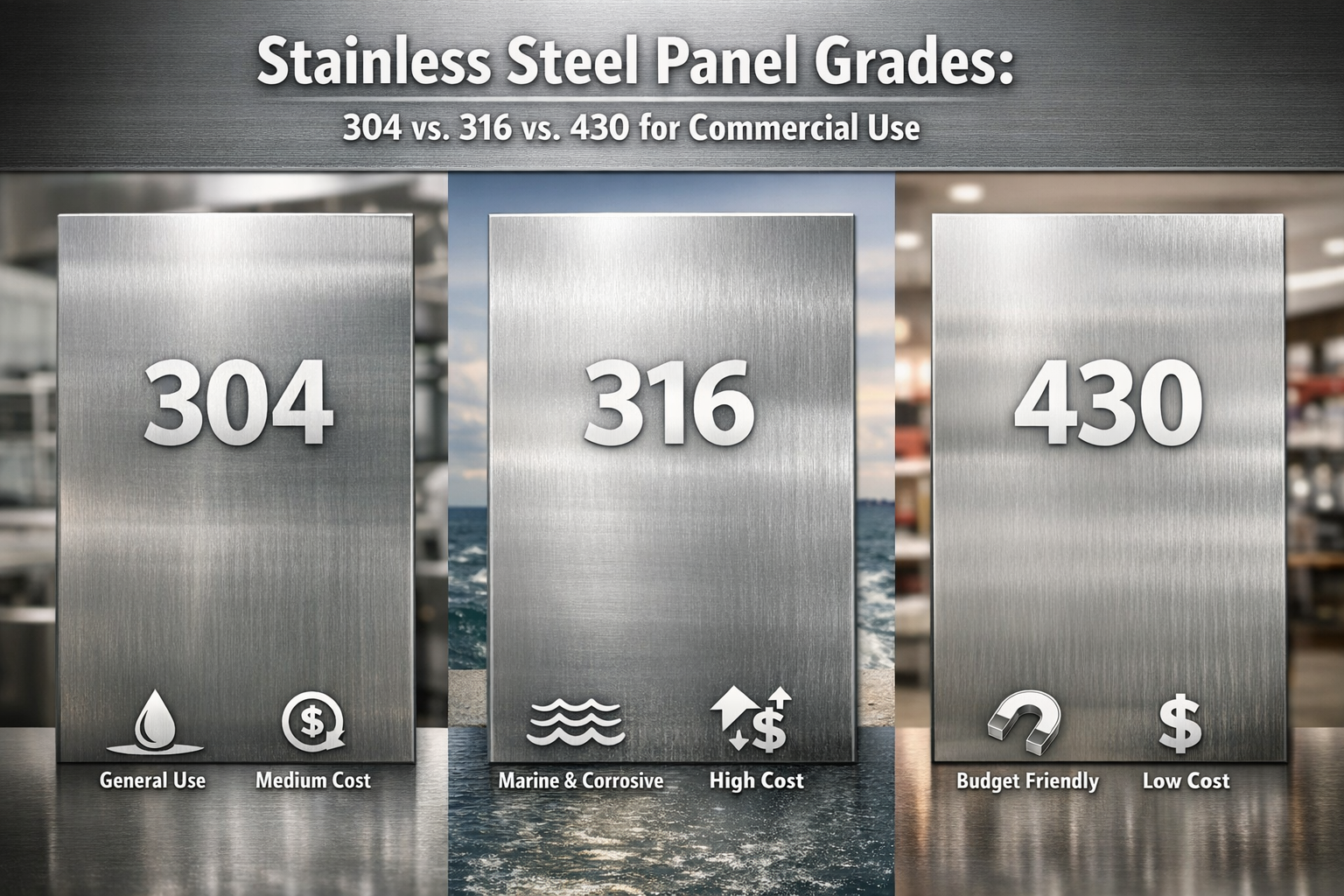
304 stainless steel is the versatile, go-to option for most commercial interiors.
-
316 stainless steel is the premium choice for corrosive, coastal, or high-risk environments.
-
430 stainless steel offers a budget-friendly solution for decorative and low-exposure applications.
By understanding the strengths and limitations of each grade, you can specify stainless steel panels that deliver the right balance of performance, appearance, and cost—ensuring durability and peace of mind for years to come.