

Stainless Steel Panel Grades Explained: Which One Is Right for You?
Apr 13th 2026
Choosing the wrong stainless steel grade is a costly mistake. Here’s everything you need to know to specify the right panel for your application — the first time.
Walk into any commercial kitchen, food processing facility, hospital, or industrial plant and you’ll almost certainly find stainless steel on the walls. But not all stainless steel is the same. The grade stamped on a mill certificate determines how the panel will perform over years of real-world use — its corrosion resistance, chemical compatibility, heat tolerance, and compliance with food safety standards.
Specifying the wrong grade is a mistake that shows up later: pitting, surface rust, failed health inspections, or panels that need replacing in five years instead of twenty-five. Getting it right upfront costs nothing extra and saves significantly in the long run.
At Waterloo Paneling, we work with operators, contractors, and facility managers every day to match the right stainless steel panel grade to the right application. This guide breaks down every major grade, what makes each one unique, and exactly when to use each one.
What Makes Stainless Steel “Stainless”?
All stainless steel is an iron-based alloy containing a minimum of 10.5% chromium. That chromium content is the key — it reacts with oxygen in the air to form a thin, invisible chromium oxide layer on the surface called the “passive layer.” This passive layer is self-repairing and is what gives stainless steel its corrosion resistance.
Beyond chromium, different grades add varying amounts of nickel, molybdenum, manganese, and other elements to achieve specific performance characteristics. The resulting differences in corrosion resistance, formability, weldability, and cost are significant — which is why grade selection matters so much in commercial and industrial applications.
Stainless steel grades are organized into families based on their metallurgical structure. The two most relevant families for wall panel applications are:
- Austenitic (300 series) — The most widely used family. Non-magnetic, highly formable, excellent corrosion resistance, and available in food-grade specifications. Includes the workhorse grades 304 and 316. The right choice for commercial kitchens, food processing, healthcare, and most industrial environments.
- Ferritic (400 series) — Magnetic, lower cost, good corrosion resistance in mild environments, but significantly less resistant to chlorides and acids than austenitic grades. Grade 430 is the most common ferritic wall panel grade. Best suited for light-duty commercial or decorative applications where food safety compliance is not required.
Grade 304: The Commercial Kitchen Standard
Composition & Properties
Grade 304 contains 18% chromium and 8% nickel — which is why it’s often called “18/8 stainless.” This composition gives it excellent resistance to a broad range of corrosive environments, including food acids, humidity, steam, and most commercial cleaning chemicals.
304 is austenitic, meaning it’s non-magnetic, highly formable, and weldable — making it easy to fabricate into custom panel sizes, trim pieces, and corner profiles. It is the most widely produced and stocked stainless steel grade in the world.
Performance in Commercial Kitchens
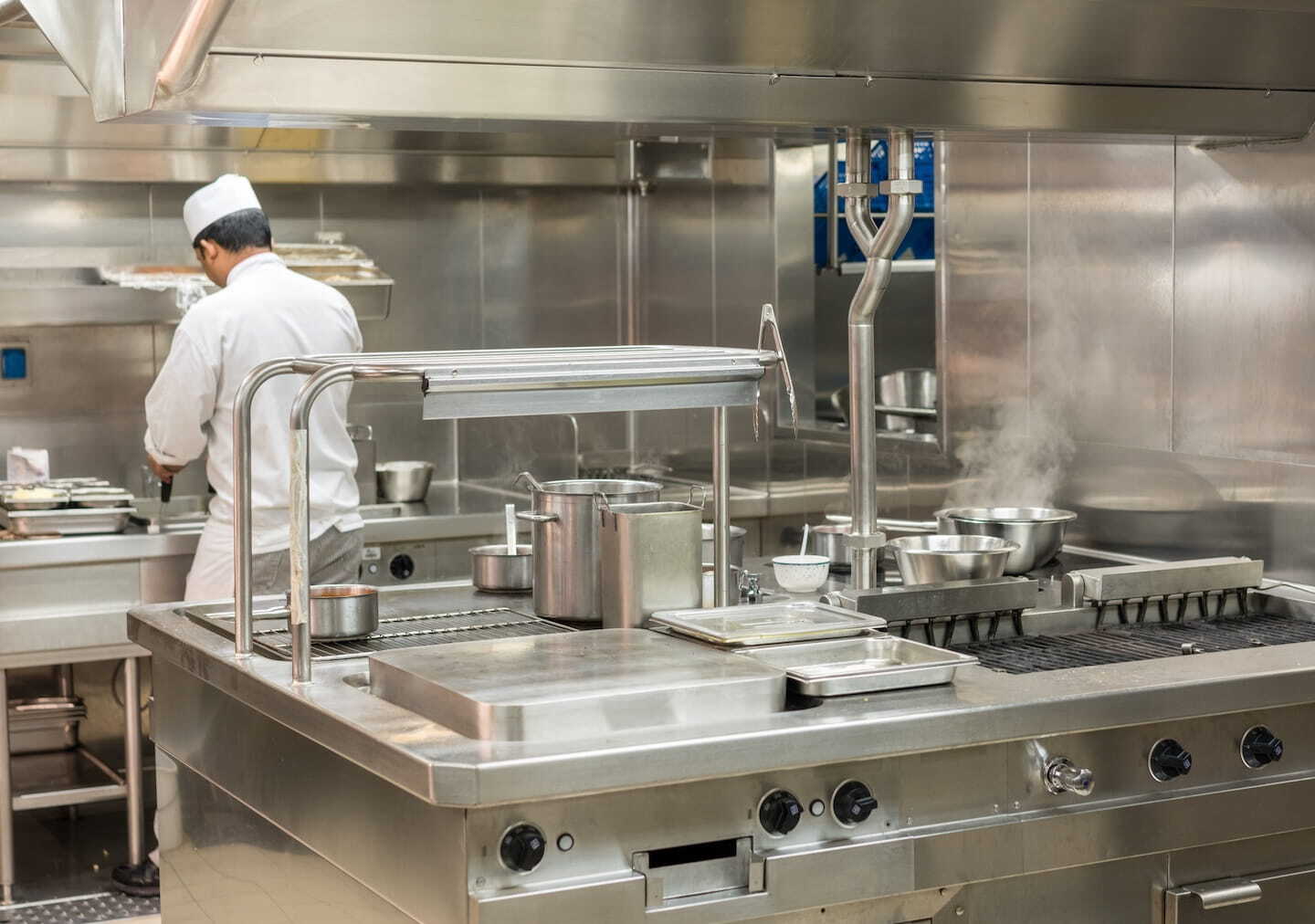
Grade 304 handles everything a standard commercial kitchen throws at it: grease splatter, steam, food acids, quaternary ammonium sanitizers, standard-concentration chlorine-based cleaners, and routine impact from carts and equipment. It meets NSF/ANSI 2 food equipment surface standards and satisfies FDA Food Code Section 4-101 requirements for food-splash and food-contact surfaces.
Under normal commercial kitchen conditions — daily cleaning, moderate chemical exposure, moderate heat — properly installed 304-grade panels will last 20 to 30 years without surface degradation.
When to Specify Grade 304
- Restaurant cooking lines, prep areas, and dishwashing zones
- Commercial bakery and food prep facility walls
- Healthcare facility kitchens and cafeterias
- Walk-in cooler and freezer interiors
- School cafeteria and institutional kitchen walls
- Any application where NSF compliance is required and chloride exposure is standard or low
When Grade 304 Is NOT Enough
Grade 304 is not recommended for environments with prolonged exposure to high-concentration chlorine sanitizers, seawater or salt air, or continuous contact with chloride-rich chemicals. In these environments, the passive layer can break down and lead to pitting corrosion — which is when 316 becomes the correct specification.
Grade 316: Maximum Corrosion Resistance

Composition & Properties
Grade 316 builds on 304’s 18% chromium / 8–10% nickel base by adding 2–3% molybdenum. That molybdenum addition dramatically improves resistance to chloride-induced pitting and crevice corrosion — the specific failure mode that affects 304 in harsh chemical or marine environments.
316 is also austenitic, non-magnetic, and weldable. It is available in the same range of gauges and finishes as 304 and meets all the same NSF food equipment standards. The primary difference is performance in aggressive environments, not general fabrication characteristics.
When 316 Is the Right Choice
Grade 316 becomes the correct specification when the environment exceeds what 304 can reliably handle long-term. The key driver is chloride exposure — either from cleaning chemicals, environmental salt air, or the food products being processed.
- Seafood processing plants — where brine, saltwater, and marine organisms create a highly aggressive chloride environment
- Coastal restaurant kitchens — where salt air infiltration accelerates surface corrosion on 304 panels over time
- Facilities using high-concentration chlorine sanitizers (above standard dilution ratios) on a daily basis
- Canning and pickling facilities — where acidic brine solutions are present continuously
- Marine and offshore food service environments
- Any application where a 20–40% premium over 304 is justified by the corrosive environment
Cost Consideration
Grade 316 typically costs 20–40% more than equivalent 304 panels. For the vast majority of inland restaurant kitchens and standard food service operations, that premium is not justified — 304 will perform equally well for decades. Specify 316 when the environment genuinely demands it, not as a default upgrade.
Grade 430: The Light-Duty Ferritic Option
Grade 430 is the most commonly used ferritic stainless steel for wall panel applications. Its composition — 16–18% chromium, no nickel — gives it good corrosion resistance in mild environments and a lower cost than austenitic grades.
Where Grade 430 Works
- Decorative commercial applications where hygiene compliance is not required
- Light-duty dry storage or utility rooms with minimal chemical exposure
- Appliance panels, equipment cladding, and trim in low-moisture environments
- Budget-conscious applications where food safety certification is not required
Where Grade 430 Falls Short
Grade 430 is magnetic, less formable than austenitic grades, and significantly more susceptible to corrosion from food acids, cleaning chemicals, and moisture than either 304 or 316. It should not be specified for active food prep zones, cooking lines, or dishwashing areas. It does not meet the same NSF food surface standards as 304 or 316 in most jurisdictions.
If you’re tempted to specify 430 to save money in a commercial kitchen, the long-term maintenance and replacement costs will almost certainly erase the upfront savings within 5–10 years.
Surface Finishes: How They Interact with Grade Selection
Grade and finish are two separate but related decisions. The grade determines corrosion resistance and compliance; the finish determines appearance, cleanability, and surface smoothness. Here’s how the major finishes map to commercial kitchen applications:
#2B Mill Finish
Smooth, cold-rolled, and semi-reflective. The most uniform and consistent surface available, with minimal surface texture. Available in 304 and 316. Preferred for food processing environments and clean rooms where maximum surface smoothness is required. Easier to sanitize thoroughly than textured finishes.
#4 Brushed Finish
The most widely specified finish for commercial kitchen wall panels. A directional satin grain that hides minor scratches and fingerprints far better than mirror finishes, wipes clean easily, and satisfies virtually every health inspector. Available in 304 and 316. The default recommendation for cooking lines, prep areas, and dishwashing zones.
#8 Mirror Finish
Highly polished and reflective. Visually striking but impractical for active kitchen walls — shows every fingerprint and requires constant upkeep to maintain appearance. Best reserved for front-of-house display areas, service counters, or decorative features where the aesthetic payoff justifies the maintenance requirement. Available in 304 and 316.
Embossed & Patterned Finishes
Custom textures and patterns are available from some fabricators, including Waterloo Paneling. These finishes can add visual interest to commercial spaces but complicate thorough sanitation in food prep environments. Verify with your local health authority before specifying a textured finish in a regulated food zone.
As a general rule: specify the grade first based on your environment’s corrosive demands, then select the finish based on your sanitation protocol and aesthetic requirements.
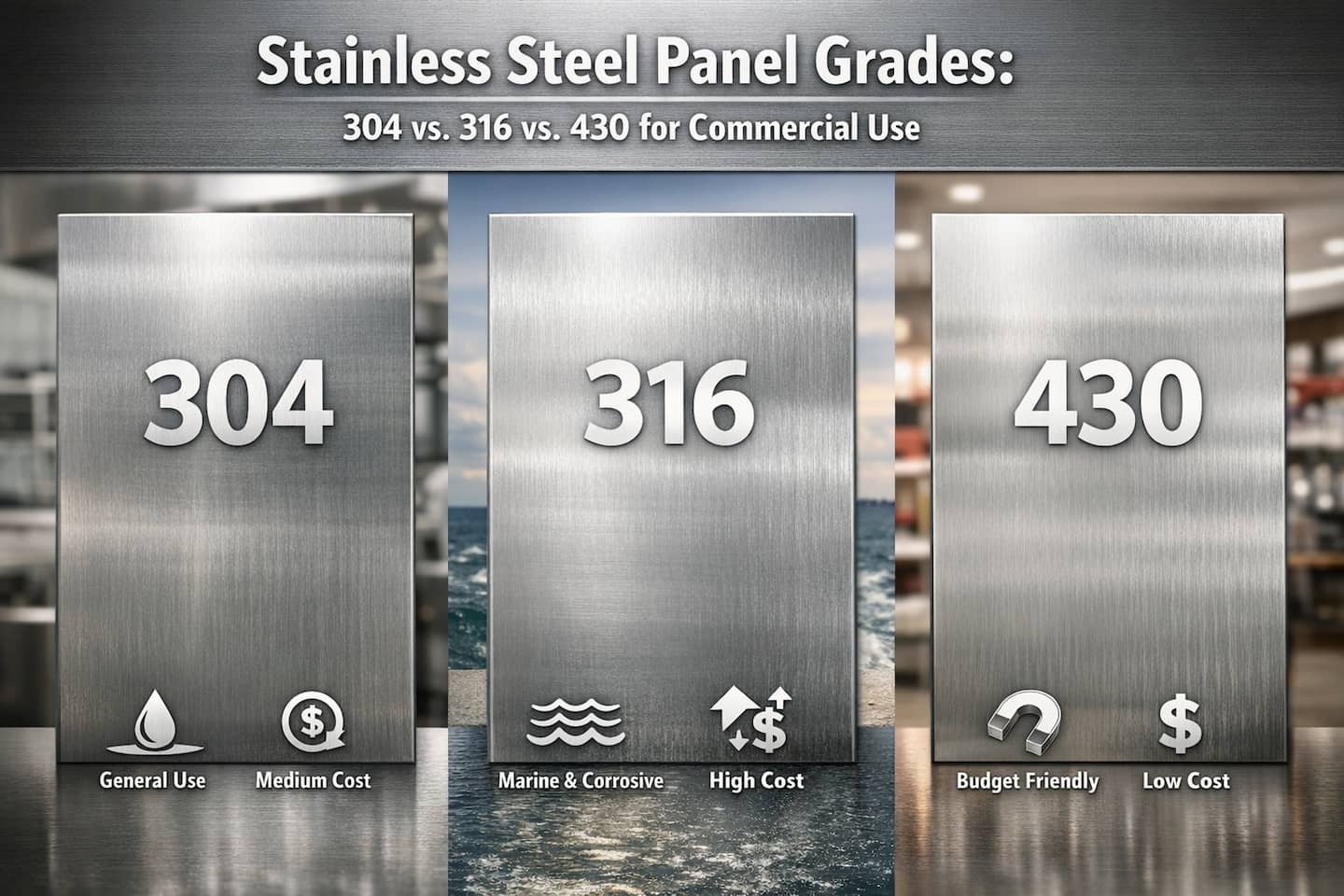
Grade Comparison: 304 vs. 316 vs. 430 at a Glance
Corrosion Resistance
- Grade 304 — Excellent resistance to food acids, humidity, steam, and standard commercial cleaners. Handles most restaurant and food service environments reliably for 20+ years.
- Grade 316 — Superior resistance to chloride-induced pitting. The right choice when 304’s performance ceiling is not enough for the specific environment.
- Grade 430 — Good resistance in mild, dry environments. Not suitable for active food prep, wet zones, or chemical-heavy cleaning protocols.
NSF / Food Safety Compliance
- Grade 304 — NSF/ANSI 2 listed. Meets FDA Food Code Section 4-101. The standard specification for health-code-compliant commercial kitchen wall panels.
- Grade 316 — NSF/ANSI 2 listed. Meets FDA Food Code Section 4-101. The premium specification for high-chloride or aggressive environments.
- Grade 430 — Not NSF-listed for food contact surfaces in most jurisdictions. Verify local requirements before specifying in regulated food areas.
Relative Cost
- Grade 304 — Baseline. The most cost-effective food-grade stainless steel panel option.
- Grade 316 — Approximately 20–40% premium over 304. Justified in aggressive environments, not as a default upgrade.
- Grade 430 — Approximately 20–30% less than 304. Lower cost comes with significant performance trade-offs in active kitchen environments.
Magnetic Properties
- Grade 304 — Non-magnetic (austenitic). Cannot be held by standard magnets.
- Grade 316 — Non-magnetic (austenitic). Cannot be held by standard magnets.
- Grade 430 — Magnetic (ferritic). Will hold magnets — a quick field test to distinguish 430 from 304/316.
Gauge: The Other Half of the Specification
Alongside grade, gauge (thickness) is the other critical specification for stainless steel wall panels. Grade determines corrosion resistance; gauge determines structural performance and dent resistance.
Common Gauges for Commercial Wall Panels
- 16 gauge (0.060” / 1.5 mm) — The recommended standard for active commercial kitchen walls: cooking lines, prep areas, dishwashing zones. Provides excellent dent resistance under daily operational impact. The right choice when longevity and performance are the priority.
- 18 gauge (0.048” / 1.2 mm) — Suitable for moderate-traffic areas such as back-of-house corridors, server stations, and light prep zones. A reasonable balance of performance and cost savings.
- 20 gauge (0.036” / 0.9 mm) — Acceptable for low-impact areas: dry storage rooms, utility corridors, office kitchen walls. Not recommended for cooking lines or dishwashing zones where daily physical impact is heavy.
- 22 gauge and thinner — Light-duty decorative applications only. Not appropriate for commercial kitchen active zones under any circumstances.
The combination of grade and gauge determines the panel’s overall performance profile. For most commercial kitchens, the correct specification is 16-gauge 304 stainless in a #4 brushed finish — for coastal, seafood, or heavy-chloride environments, upgrade to 16-gauge 316.
How to Verify the Grade You’re Getting
Grade fraud and misrepresentation in stainless steel supply chains is a real issue, particularly with imported material. Here’s how to protect your project:
- Request mill certifications — A reputable supplier will provide original mill certificates (also called Material Test Reports or MTRs) showing the alloy composition, mechanical properties, heat number, and country of origin for every coil or sheet. This is non-negotiable for any food service or regulated application.
- Verify the alloy composition in the MTR — For 304, confirm 18–20% chromium and 8–10.5% nickel. For 316, confirm 16–18% chromium, 10–14% nickel, and 2–3% molybdenum. For 430, confirm 16–18% chromium and no nickel.
- Use the magnet test as a field screen — 304 and 316 are non-magnetic; 430 is magnetic. A panel that holds a magnet in an application specified as 304 or 316 warrants further investigation.
- Request NSF documentation separately — The MTR confirms the alloy; NSF listing documentation confirms the panel has been tested and listed under NSF/ANSI 2 for food equipment surface applications. Both documents should be on file before installation in a regulated food prep environment.
- Work with reputable domestic or traceable import suppliers — At Waterloo Paneling, all panels come with full mill certification and traceability documentation as standard practice.
Frequently Asked Questions
What is the most common stainless steel panel grade used in commercial kitchens?
Grade 304 in a #4 brushed finish is by far the most common specification for commercial kitchen wall panels in the United States. It satisfies NSF/ANSI 2 and FDA Food Code requirements, handles standard commercial cleaning chemicals without degradation, and provides a 20–30 year service life under normal conditions.
Is 304 or 316 stainless steel better for kitchen walls?
For most inland restaurant kitchens and standard food service operations, 304 is the better choice — it performs equally well at a lower cost. 316 is the correct specification when the environment involves high chloride exposure: seafood processing, coastal locations, or facilities using high-concentration chlorine sanitizers routinely. Specifying 316 as a default upgrade for a standard restaurant kitchen is not necessary and adds cost without meaningful benefit.
Can I use Grade 430 stainless steel in a commercial kitchen?
Grade 430 is generally not appropriate for active food prep, cooking line, or dishwashing wall applications in commercial kitchens. It lacks the corrosion resistance needed for chemical-heavy cleaning protocols and does not carry NSF food surface listings in most jurisdictions. It is an acceptable choice for low-moisture, light-duty, non-regulated back-of-house areas such as dry storage rooms.
How do I tell what grade my existing stainless steel panels are?
The quickest field test is a magnet: 304 and 316 are non-magnetic; 430 is magnetic. For a definitive answer, request the original mill certifications from the installer or supplier. If those are unavailable, a third-party lab can perform an X-ray fluorescence (XRF) analysis to determine the alloy composition from the panel surface non-destructively.
Does stainless steel grade affect the panel’s appearance?
Grade does not affect appearance — a #4 brushed 304 panel and a #4 brushed 316 panel look identical to the eye. The finish (2B, #4, #8, embossed) determines the visual appearance; the grade determines the corrosion performance behind that appearance. This is why proper documentation matters: you cannot visually distinguish 304 from 316 after installation.
What gauge stainless steel wall panel should I specify for a busy restaurant kitchen?
16 gauge is the recommended specification for active commercial kitchen zones — cooking lines, prep areas, and dishwashing areas. It provides the best dent resistance under daily operational impact and is the specification most commonly required by health inspectors and contractors for high-use environments.
Need Help Specifying the Right Stainless Steel Panel Grade?
Grade selection mistakes are expensive. The wrong specification means premature corrosion, failed inspections, and panels that need replacing years ahead of schedule. The right specification means 20–30 years of reliable, low-maintenance performance.
At Waterloo Paneling, our team works with commercial kitchen operators, general contractors, and facility managers every day to match the right grade, gauge, and finish to the right application. We supply mill-certified 304 and 316 stainless steel wall panels in standard and custom sizes, with full NSF documentation included.
► Get a Free Specification Consultation from Waterloo Paneling ◄
Contact our team to discuss your project environment, get a custom quote, or request panel samples to evaluate finish options before you commit.